
 Swedish
  English
 Bröstförstoring
Preoperativ fas med Dr. Tolga Aksan
Konsultation och Utvärdering:
- Medicinsk Historik och Fysisk Undersökning: Dr. Aksan takes a comprehensive medical history, including any previous surgeries, current medications, and general health.
- Discussion of Goals: Dr. Aksan discusses the patient’s aesthetic aspirations, focusing on desired breast size, shape, and any asymmetry.
- Breast Examination: Dr. Aksan assesses breast size, skin quality, and nipple position, essential for planning.
Preoperative Tests:
- Complete Blood Count (CBC): To check for anemia, infection, and other blood-related issues.
- Coagulation Profile: Including PT (Prothrombin Time) and aPTT (Activated Partial Thromboplastin Time) to assess blood clotting.
- Electrolyte Panel: To check the balance of sodium, potassium, chloride, and bicarbonate in your body.
- Blood Urea Nitrogen (BUN) and Creatinine: To assess kidney function.
- Liver Function Tests: To evaluate the health of your liver.
- Fasting Blood Sugar: To check for diabetes or pre-diabetes conditions.
- Lipid Profile: To assess cholesterol levels.
- Urine Analysis: To detect any urinary tract infections or kidney issues.
- Pregnancy Test (if applicable): To rule out pregnancy before the surgery.
- EKG (Electrocardiogram): Especially for patients over 40 years or with cardiac risk factors, to check heart function.
- Chest X-Ray: To evaluate lung health and rule out respiratory issues.
- Hemoglobin A1C: For patients with diabetes, to assess blood sugar control over the last three months.
- HIV and Hepatitis Panel: Depending on the clinic’s policy and patient’s risk factors.
- COVID-19 Test: Depending on current health guidelines and policies.
Planning and Drawings:
- Dr. Aksan marks the breast area while the patient is standing, crucial for planning incisions and implant placement.
- Decisions on implant type (silicone or saline), size, shape, and placement (above or below the muscle) are finalized.
Surgical Procedure by Dr. Tolga Aksan
Anesthesia:
- Typically performed under general anesthesia.
Incision:
- Dr. Aksan makes incisions, usually under the breast, around the areola, or under the arm.
- The choice of incision is based on implant type, enlargement degree, patient’s anatomy, and Dr. Aksan’s expertise.

Creating the Pocket:
- A pocket for the implant is created either above or below the pectoral muscle.
- Submuscular placement can be beneficial for certain patients.
Inserting and Placing the Implant:
- Dr. Aksan inserts and positions the implants within the pockets, ensuring proper placement and symmetry.
Closing the Incisions:
- Incisions are meticulously closed to minimize scarring.
Postoperative Care by Dr. Tolga Aksan's Team
Immediate Recovery:
- Observation in a recovery room.
- Management of pain, swelling, and bruising.
Postoperative Instructions:
- Care for the incision site, medications, and limitations on physical activity.
- Support bra is recommended for a 6 weeks period.
Follow-up Visits:
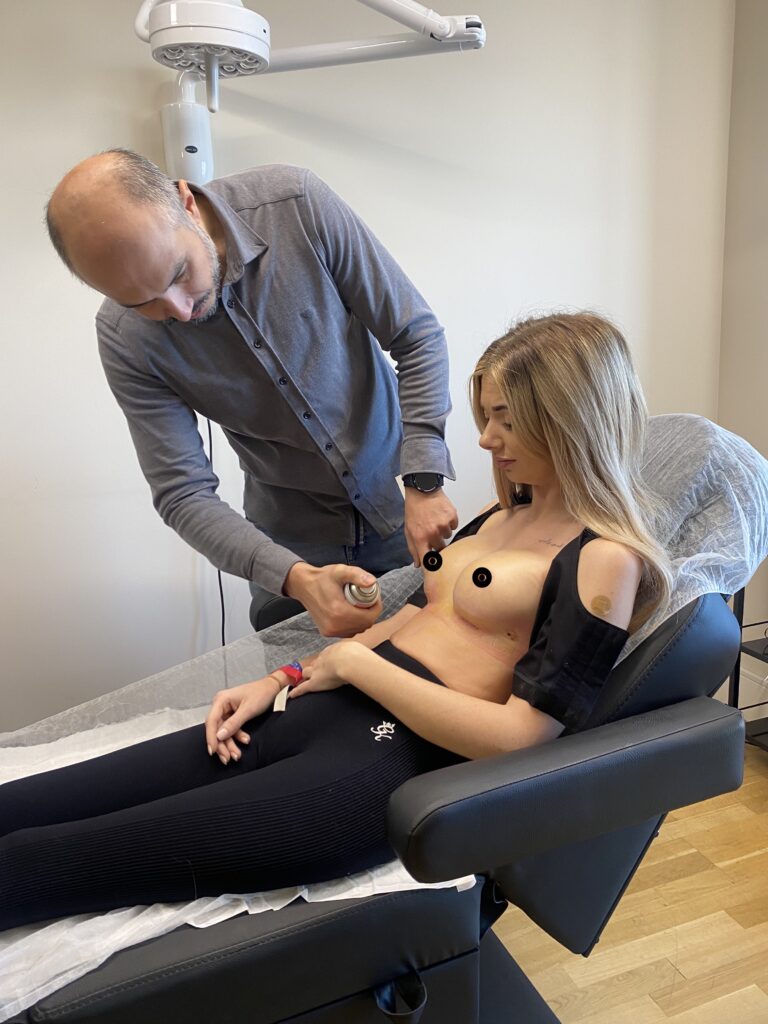
- Scheduled with Dr. Aksan to monitor healing and progress.
Long-Term Care:
- Regular check-ups and mammograms as advised by Dr. Aksan.
- Patient education on breast health monitoring.
Final Results:
- Breast shape and size settle over months, and scars mature and fade over time.
Technique Variations
- Implant Type: Silicone for natural feel or saline for smaller incisions, as per Dr. Aksan’s recommendation.
- Implant Shape: Round for fullness or anatomical for a natural slope, depending on the desired outcome.
- Placement Technique: Dual Plane Placement or other techniques as per Dr. Aksan’s assessment.
Dr. Aksan ensures that each patient is well-informed about the procedure, risks, and expectations. His personalized approach and surgical expertise contribute significantly to achieving desired and satisfying outcomes in breast augmentation.